❮
![Large Image]() ❯
❯
3rd Minnesota Infantry - Captured at Murfreesboro
Item CDV-11818
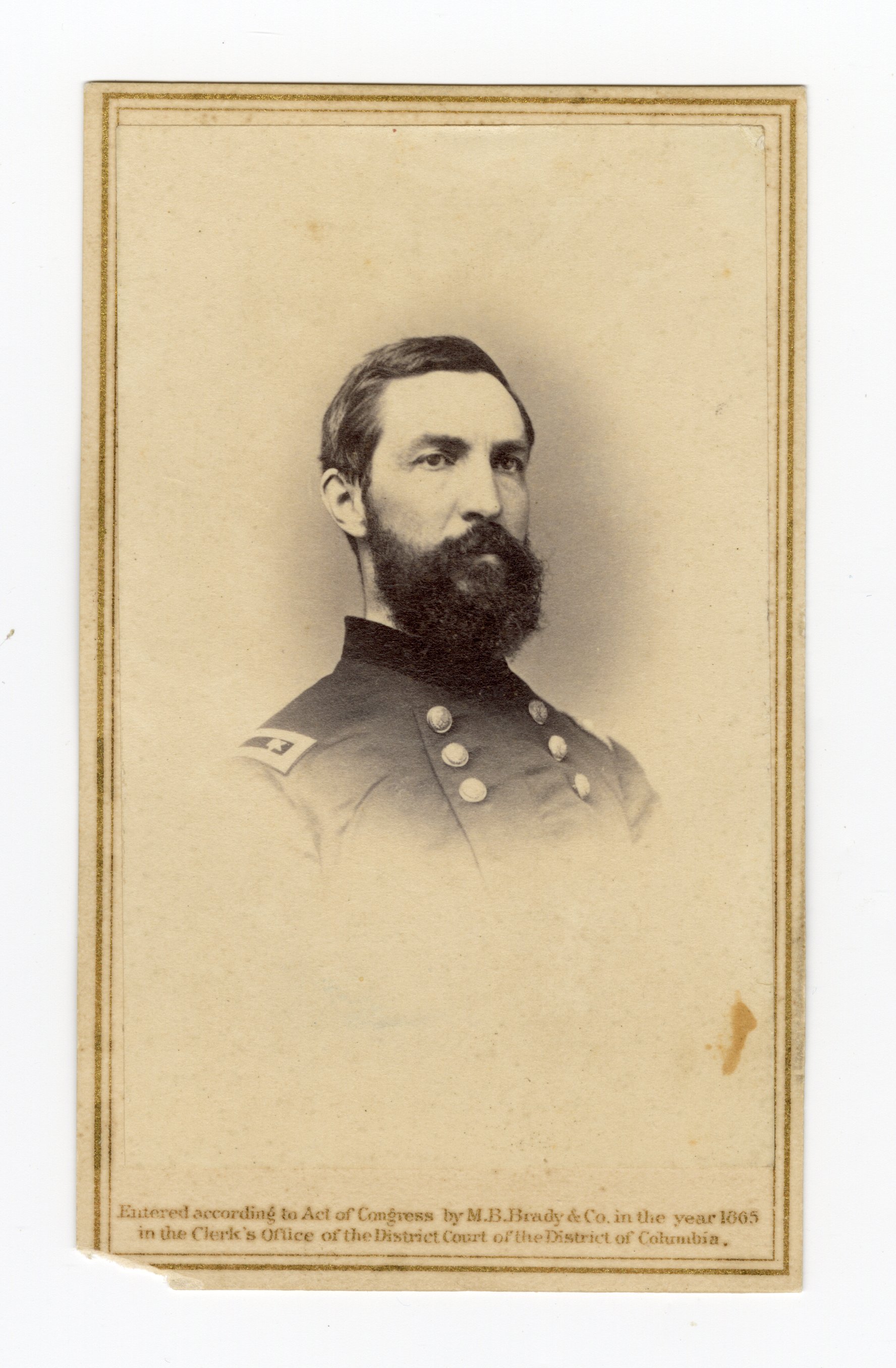
Christopher C. Andrews
Price: $485.00
Description
Christopher Columbus Andrews (October 27, 1829 – September 21, 1922) was an American soldier, diplomat, newspaperman, author, and forester.During the Civil War, Andrews rose to the rank of brigadier general and at its close was brevetted as a major general. He originally enlisted as a private, but was commissioned captain in the 3rd Minnesota Infantry. Captured by Confederates in Tennessee in July 1862, he was held as a prisoner of war until October, when he was exchanged. He returned to his regiment as lieutenant colonel and participated in the Vicksburg Campaign.
In July 1863, Andrews was promoted to colonel and commanded a brigade in the operations to capture Little Rock, Arkansas, later in the year. Throughout the balance of the year and into early 1864, Andrews helped organize and foster the Unionists in Arkansas and was influential in the reorganization of Arkansas as a free state. He was promoted to brigadier general in acknowledgment of his efforts while commanding troops near Augusta, Arkansas. Andrews was assigned to the command of the Second Division of the XIII Corps, and participated in the siege and storming of Fort Blakeley in Alabama. On March 9, 1865, he was brevetted Major General and assigned command of the district of Mobile.
Andrews was dispatched to Houston, Texas, to supervise the early stages of Reconstruction in the region and to keep the order while a new provisional civil government was put in place under Governor Andrew J. Hamilton. He mustered out of the service on January 15, 1866. He was a companion of the Minnesota Commandery of the Military Order of the Loyal Legion of the United States - a military society of officers who had served in the Union armed forces during the American Civil War.
Andrews was appointed by President Grant as United States Minister to Denmark on April 16, 1869, and was sworn into office but never proceeded to his post. He was then appointed as United States Minister to Sweden and Norway and served from 1869 to 1877. He served as United States Consul-General to the Empire of Brazil from 1882 to 1885. He helped supervise the 1880 census for Minnesota.
After the war, Andrews, interested in scientific forestry, worked to stir public sentiment for responsible logging and forest practices, but without much success until the Great Hinckley Fire of 1894 burned several towns in east-central Minnesota, garnering widespread public attention. He maintained that proper forestry would renew the state's ravaged timberlands and make them fire-resistant. Eventually, leading foresters and companies began to implement Andrews' ideas and practices. He was Minnesota state Forestry Commissioner when the Baudette Fire of 1910 burned, further strengthening his argument for regulation of forestry.
Source: Wikipedia