
❮
![Large Image]() ❯
2nd Michigan Cavalry - NEW
Item CDV-12166
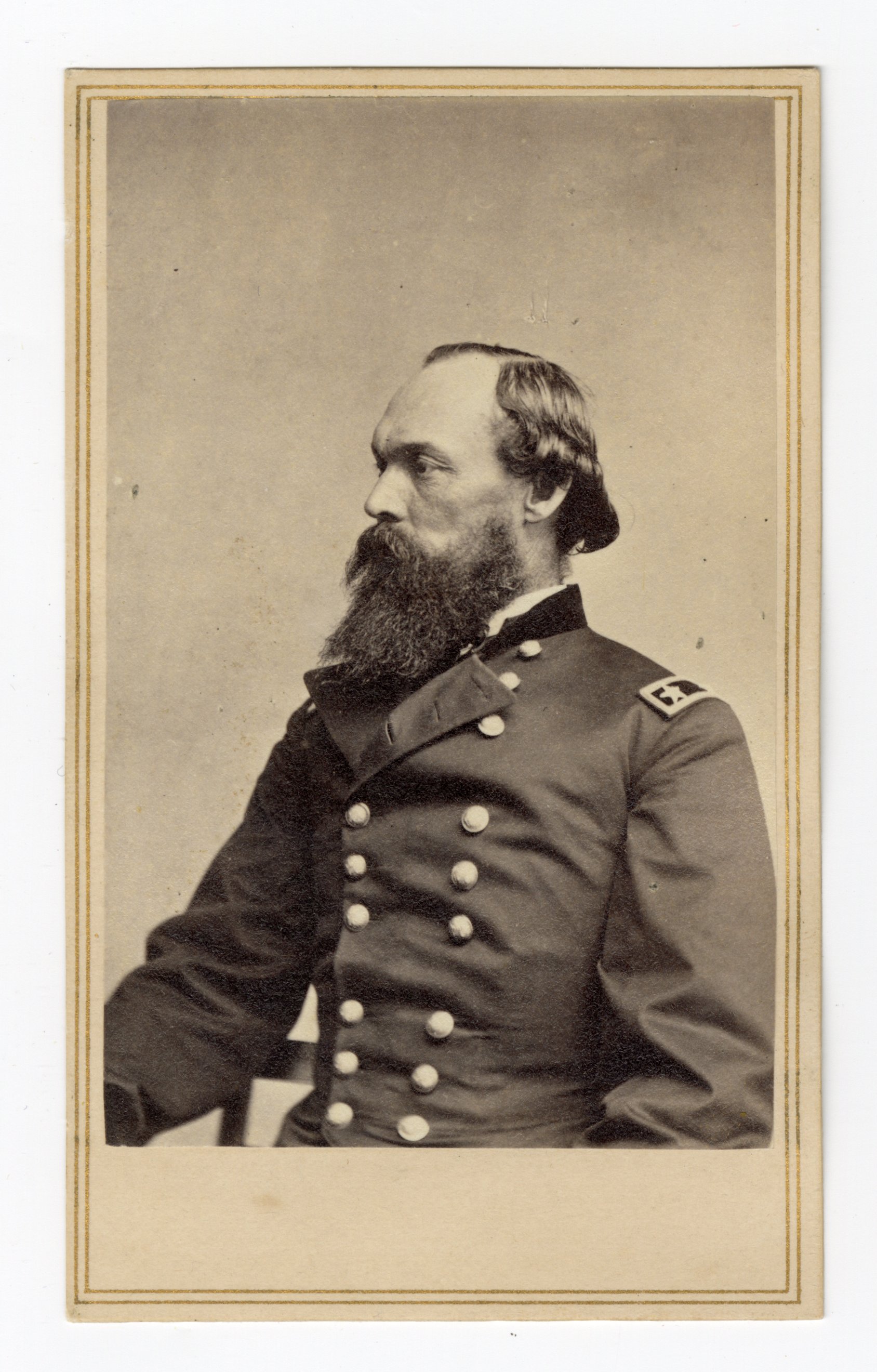
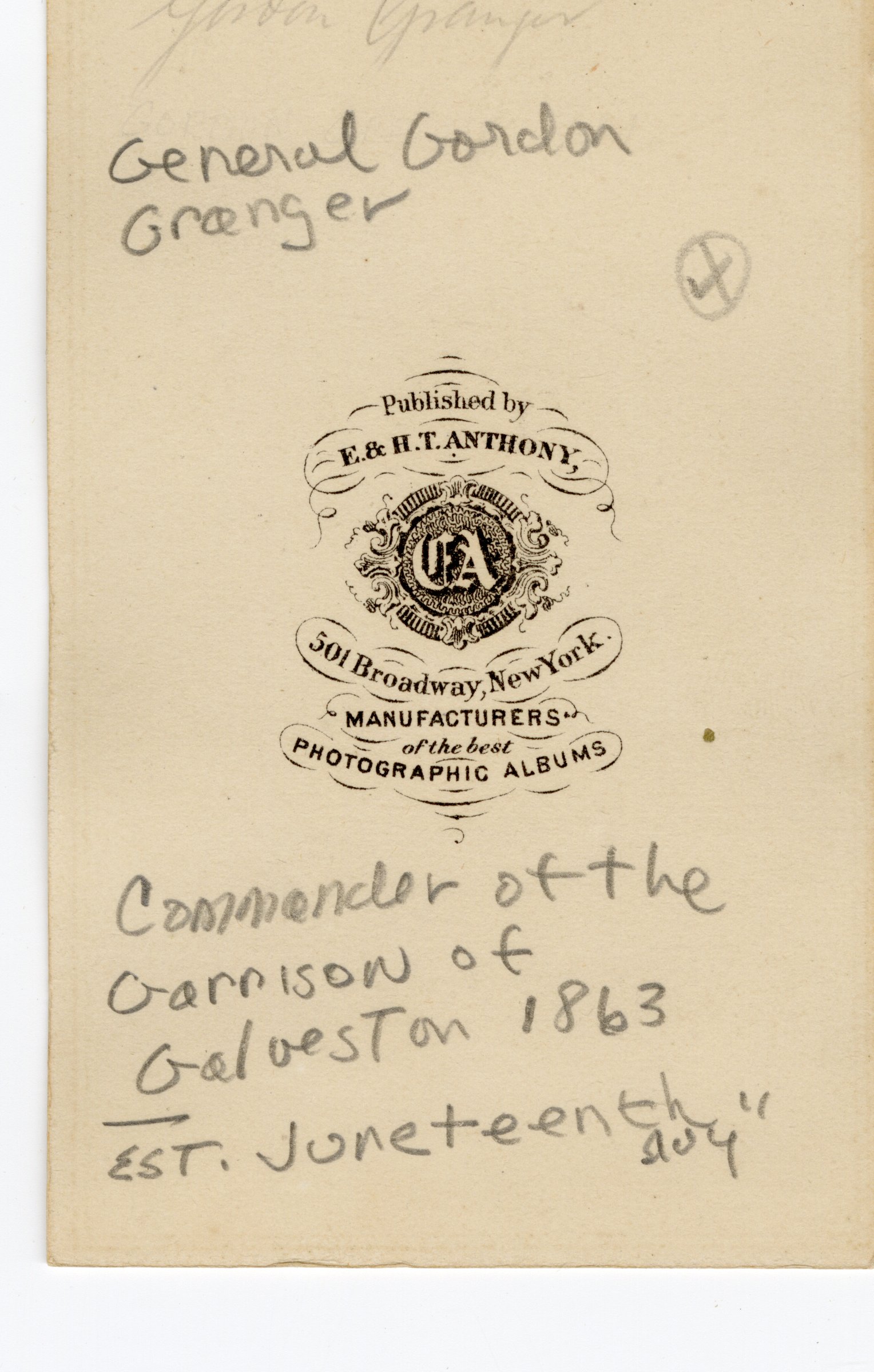
Gordon Granger
Price: $475.00
Description
Gordon Granger (November 6, 1821 – January 10, 1876) was a career U.S. Army officer, and a Union general during the American Civil War, where he distinguished himself at the Battle of Chickamauga.Granger is best remembered for his part in the Battle of Chickamauga and the Battle of Chattanooga and for issuing General Order No. 3 on June 19, 1865, in Galveston, Texas, further informing residents of, and enforcing, Abraham Lincoln's Emancipation Proclamation which set all Confederate states' slaves free on January 1, 1863. Since 2021, June 19 has been commemorated by the federal holiday of Juneteenth.
Granger was born in Joy, Wayne County, New York, in 1821 to Gaius Granger and Catherine Taylor being one of three children in his family. His mother died on April 17, 1825, one month after giving birth to a daughter. His father married again in November 1826 to Sara (Salley) Emery and the two would have 10 children. He spent his early years with his paternal grandparents (Elihu and Apema or Apama Granger) in Phelps, New York. While attending high school he developed health issues which carried on throughout his life. He was a teacher in North Rose, New York, prior to entering the United States Military Academy.
Granger was appointed to the academy in 1841 when he was 19 years old. While there he met John Pope who later became one of his mentors. It is possible that his grudge with Ulysses S. Grant started when he was there with Grant holding the grudge more than Granger. He graduated from the United States Military Academy in 1845 placed thirty-fifth in a class of forty-one cadets. He was commissioned a brevet second lieutenant and assigned to the Second Infantry Regiment stationed in Detroit, Michigan. In July 1846 he transferred to the newly constituted Regiment of Mounted Riflemen at Jefferson Barracks, Missouri.
When the Civil War started, Granger was on sick leave. He was temporarily assigned to the staff of General George B. McClellan in Ohio. After recovering, he transferred back to the Regiment of Mounted Riflemen where he was promoted to captain in May 1861. As an adjutant of General Samuel D. Sturgis he saw action at the Battle of Dug Springs and observed the Union defeat at Wilson's Creek in August 1861 in Missouri, serving as a staff officer to General Nathaniel Lyon. Granger was cited for gallantry at Wilson's Creek, became a brevet major and was made a commander of the St. Louis Arsenal.
In November 1861, Granger assumed command of the 2nd Michigan Cavalry Regiment at Benton Barracks in St. Louis, becoming a colonel of volunteers. One of the Union veterans wrote in a memoir that Granger's "military genius soon asserted itself by many severe lessons to the volunteer officers and men of this regiment. He brought them up to the full standard of regulars within a period of three months," and "though a gruff appearing man, had succeeded in winning the respect of his regiment by his strict attention to all the details of making a well-disciplined body of soldiers out of a mass of awkward men from every walk of life."
In February 1862, on the orders of General John Pope, the 2nd Michigan proceeded from St. Louis to Commerce, Missouri, where Pope assembled nearly 20,000 Union troops for an advance on New Madrid, Missouri. Granger assumed command over the Third Cavalry Brigade consisting of the 2nd and the 3rd Michigan cavalry regiments. After the 7th Illinois joined the brigade, it was reorganized into a cavalry division.
On March 26, 1862, Granger was promoted to brigadier general of volunteers and commanded the Cavalry Division, Army of the Mississippi during the Battle of New Madrid and the Siege of Corinth. He was promoted to major general of volunteers on September 17, 1862, and took command of the Army of Kentucky. He conducted cavalry operations in central Tennessee before his command was merged into the Army of the Cumberland, becoming the Reserve Corps.
Granger's effective leadership at Chickamauga earned him command of the newly formed IV Corps in the Army of the Cumberland commanded by General Thomas, and he was promoted brevet lieutenant colonel of the U.S. Army. Under his command, the IV Corps force distinguished itself at the third Battle of Chattanooga. Two of the IV Corps' divisions, those commanded by Thomas J. Wood and Philip Sheridan, were in the middle of the four divisions that assaulted the heavily manned center of the Confederate lines on Missionary Ridge. Although they had no further orders after taking the rifle-pits at the base, Granger's men kept going up the steep ridge, with the two other divisions just slightly behind, and routed the Confederates on the crest. This breakthrough, in conjunction with Hooker's successful assault further to the right, forced the Confederates, under General Braxton Bragg, to retreat in disorder. After Chattanooga, Granger took part in lifting the siege at Knoxville, Tennessee. Despite these successes, General Ulysses S. Grant disliked Granger as the latter resisted an appeal by General Phil Sheridan to pursue the retreating Confederate army after the battle and prevented him from gaining more prominent commands in the West or in the Eastern Theater of the American Civil War. General E. R. S. Canby later offered Granger a command in the Department of the Gulf over Grant's objections, and he led a division that provided land support to the naval operations conducted by Admiral David Farragut in the Gulf of Mexico. Granger led the land forces that captured Forts Gaines and Morgan in conjunction with the Union naval operations during the Battle of Mobile Bay. Granger commanded the XIII Corps during the Battle of Fort Blakeley, which led to the fall of the city of Mobile, Alabama.
Source: Wikipedia