❮
![Large Image]() ❯
John Brown - Abolitionist - NEW
Item CDV-12168
Price: $175.00
Description
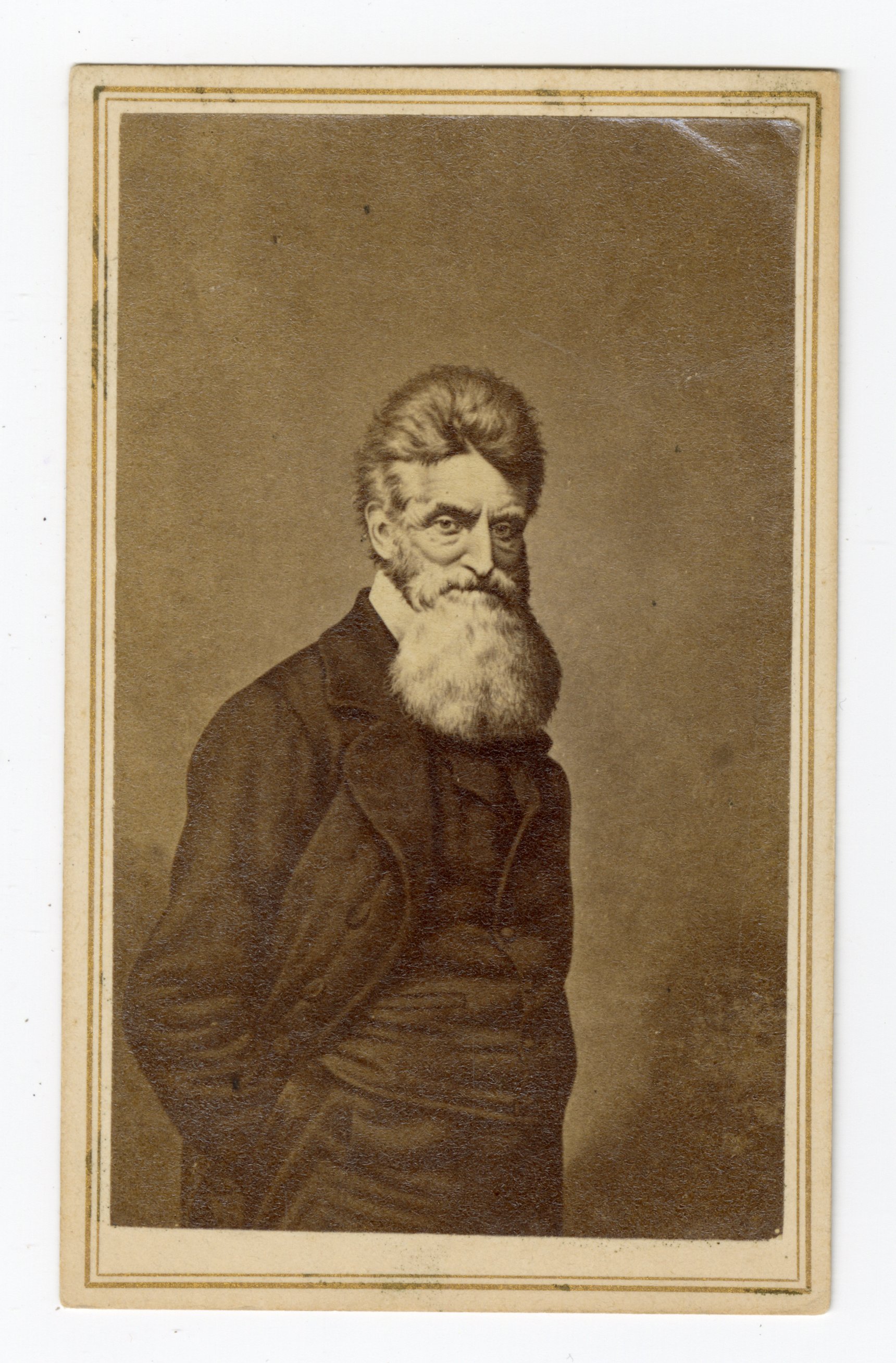
John Brown (May 9, 1800 – December 2, 1859) was an American abolitionist in the decades preceding the American Civil War. An evangelical Christian of strong religious convictions, Brown was profoundly influenced by the Puritan faith of his upbringing. He believed that he was "an instrument of God", raised to strike the "death blow" to slavery in the United States, a "sacred obligation". Brown was the leading exponent of violence in the American abolitionist movement, viewing that it was necessary to end slavery after decades of peaceful efforts had failed.Brown said that in working to free the enslaved, he was following Christian ethics, including the Golden Rule, and the Declaration of Independence, which states that "all men are created equal". He stated that in his view, these two principles "meant the same thing". Brown first gained national attention when he led anti-slavery volunteers and his sons during the Bleeding Kansas crisis of the late 1850s, a state-level civil war over whether Kansas would enter the Union as a slave state or a free state. He was dissatisfied with abolitionist pacifism, saying of pacifists, "These men are all talk. What we need is action—action!" In May 1856, Brown and his sons killed five supporters of slavery in the Pottawatomie massacre, a response to the sacking of Lawrence by pro-slavery forces. Brown then commanded anti-slavery forces at the Battle of Black Jack and the Battle of Osawatomie.
In October 1859, Brown led a raid on the federal armory at Harpers Ferry, Virginia (which later became part of West Virginia), intending to start a slave liberation movement that would spread south; he had prepared a Provisional Constitution for the revised, slavery-free United States that he hoped to bring about. He seized the armory, but seven people were killed and ten or more were injured. Brown intended to arm slaves with weapons from the armory, but only a few slaves joined his revolt. Those of Brown's men who had not fled were killed or captured by local militia and U.S. Marines, the latter led by Robert E. Lee. Brown was tried for treason against the Commonwealth of Virginia, the murder of five men, and inciting a slave insurrection. He was found guilty of all charges and was hanged on December 2, 1859, the first person executed for treason in the history of the United States.
The Harpers Ferry raid and Brown's trial, both covered extensively in national newspapers, escalated tensions that in the next year led to the South's long-threatened secession from the United States and the American Civil War. Southerners feared that others would soon follow in Brown's footsteps, encouraging and arming slave rebellions. He was widely viewed as a hero in the North. Union soldiers marched to the new song "John Brown's Body" that portrayed him as a heroic martyr. Brown has been variously described as a heroic martyr and visionary, and as a madman and terrorist.
Brown's plans for a major attack on American slavery began long before the raid. According to his wife Mary, interviewed while her husband was awaiting his execution, Brown had been planning the attack for 20 years. Frederick Douglass noted that he made the plans before he fought in Kansas. For instance, he spent the years between 1842 and 1849 settling his business affairs, moving his family to the Negro community at Timbuctoo, New York, and organizing in his own mind an anti-slavery raid that would strike a significant blow against the entire slave system, running slaves off Southern plantations.
According to his first biographer James Redpath, "for thirty years, he secretly cherished the idea of being the leader of a servile insurrection: the American Moses, predestined by Omnipotence to lead the servile nations in our Southern States to freedom." An acquaintance said: "As Moses was raised up and chosen of God to deliver the Children of Israel out of Egyptian bondage, ...he was...fully convinced in his own mind that he was to be the instrument in the hands of God to effect the emancipation of the slaves."
Brown said that,
A few men in the right, and knowing that they are right, can overturn a mighty king. Fifty men, twenty men, in the Alleghenies would break slavery to pieces in two years.
Brown kept his plans a secret, including the care he took not to share the plans with his men, according to Jeremiah Anderson, one of the participants in the raid. His son Owen, the only one who survived of Brown's three participating sons, said in 1873 that he did not think his father wrote down the entire plan. He did discuss his plans at length, for over a day, with Frederick Douglass, trying unsuccessfully to persuade Douglass to accompany him to Harpers Ferry (which Douglass thought a suicidal mission).
Brown led his forces for Harper Ferry on the night of October 16, 1859. The objective was to take the armory, the arsenal, the town, and then the rifle factory. Then, they wanted to free all the slaves in Harpers Ferry. After that, they would move south with those newly freed people who wanted to join the fight to free other enslaved people. Brown told his men to take prisoners who disobeyed them and to fight only in self-defense.
Initially, they met no resistance entering the town. John Brown's raiders cut the telegraph wires and easily captured the armory, which was being defended by a single watchman. They next rounded up hostages from nearby farms, including Colonel Lewis Washington, great-grandnephew of George Washington. They also spread the news to the local slaves that their liberation was at hand.
When an eastbound Baltimore and Ohio Railroad train approached the town, Brown held it and then inexplicably allowed it to continue on its way. At the next station where the telegraph still worked, the conductor sent a telegram to B&O headquarters in Baltimore. The railroad sent telegrams to President Buchanan and Virginia Governor Henry A. Wise.
By the morning of October 18 the engine house, later known as John Brown's Fort, was surrounded by a company of U.S. Marines under the command of First Lieutenant Israel Greene, USMC, with Colonel Robert E. Lee of the United States Army in overall command.
Army First Lieutenant J. E. B. Stuart approached the engine-house to apprehend Brown and told the raiders their lives would be spared if they surrendered. Brown refused, saying, "No, I prefer to die here." Stuart then gave a signal and the Marines used sledgehammers and a makeshift battering ram to break down the engine room door. Lieutenant Israel Greene cornered Brown and struck him several times, wounding his head. In three minutes, Brown and the survivors were captives.
Altogether, Brown's men killed four townspeople and one Marine. Ten people were wounded, one of whom was a Marine. Four of Brown's men were not captured, the rest died during the raid or were captured and executed. Among the raiders killed were John Henry Kagi, Lewis Sheridan Leary, and Dangerfield Newby; those hanged besides Brown included John Copeland, Edwin Coppock, Aaron Stevens, and Shields Green. Most of the enslaved people were returned to their slaveholders, while some were able to escape capture. A man named Phil was captured with Brown, and a man named Jim drowned in the Shenandoah.
Brown and the others captured were held in the office of the armory. On October 18, 1859, Virginia Governor Henry A. Wise, Virginia Senator James M. Mason, and Representative Clement Vallandigham of Ohio arrived in Harpers Ferry. Brown conceded that he did not receive the support he expected from White and Black people. The questioning lasted several hours.
Brown was charged with treason and tried in a Virginia state court at Governor Wise's request. Accordingly, the charge was treason against Virginia. President Buchanan did not object.
The answer provided in 1859 was more political ~ than legal. The president of the United States and the governor of Virginia decided that Brown would be tried in Virginia for treason against the Commonwealth of Virginia, and that is where he was tried. This decision thrust Virginia rather than the United States into the role of the offended sovereign and contributed incalculably to the widening abyss between North and South. John Brown was condemned not as an enemy of the American people but as an enemy of Virginia and, by logical extension, of Southern slaveholders.
Brown was tried with his men who had lived through the raid and had not escaped—Copeland, Coppoc, Green, and Stevens—on charges of murder, "conspiracy to foment a slave insurrection", and treason, as of October 26.
On November 2, after a week-long trial in Charles Town, the county seat of Jefferson County, and 45 minutes of deliberation, the jury found Brown guilty on all three counts. He was sentenced to be hanged in public on December 2. He was the first person executed for treason in the history of the United States.
The trial attracted reporters who were able to send their articles via the new telegraph. They were reprinted in numerous papers. It was the first trial in the U.S. to be nationally reported.
November 2 to December 2, 1859
Before his conviction, reporters were not allowed access to Brown, as the judge and Andrew Hunter feared that his statements, if quickly published, would exacerbate tensions, especially among the enslaved. This was much to Brown's frustration, as he stated that he wanted to make a full statement of his motives and intentions through the press. Once he had been convicted, the restriction was lifted, and, glad for the publicity, he talked with reporters and anyone else who wanted to see him, except pro-slavery clergy. Brown received more letters than he ever had in his life. He wrote replies constantly, hundreds of eloquent letters, often published in newspapers.
There were well-documented and specific plans to rescue Brown, as Virginia Governor Henry A. Wise wrote to President Buchanan. Throughout the weeks Brown and six of his collaborators were in the Jefferson County Jail in Charles Town, the town was filled with various types of troops and militia, hundreds and sometimes thousands of them. Brown's trips from the jail to the courthouse and back, and especially the short trip from the jail to the gallows, were heavily guarded. Wise halted all non-military transportation on the Winchester and Potomac Railroad (from Maryland south through Harpers Ferry to Charles Town and Winchester), from the day before through the day after the execution. Jefferson County was under martial law, and the military orders in Charles Town for the execution day had 14 points.
However, Brown said several times that he did not want to be rescued. He refused the assistance of Silas Soule, a friend from Kansas who infiltrated the Jefferson County Jail one day by getting himself arrested for drunken brawling and offered to break him out during the night and flee northward to New York State and possibly Canada. Brown told Silas that, aged 59, he was too old to live a life on the run from the federal authorities as a fugitive and wanted to accept his execution as a martyr for the abolitionist cause. As Brown wrote his wife and children from jail, he believed that his "blood will do vastly more towards advancing the cause I have earnestly endeavored to promote, than all I have done in my life before." "I am worth inconceivably more to hang than for any other purpose."
Victor Hugo, from exile on Guernsey, tried to obtain a pardon for John Brown: he sent an open letter that was published by the press on both sides of the Atlantic. This text warned of a possible civil war:
Politically speaking, the murder of John Brown would be an uncorrectable sin. It would create in the Union a latent fissure that would in the long run dislocate it. Brown's agony might perhaps consolidate slavery in Virginia, but it would certainly shake the whole American democracy. You save your shame, but you kill your glory. Morally speaking, it seems a part of the human light would put itself out, that the very notion of justice and injustice would hide itself in darkness, on that day where one would see the assassination of Emancipation by Liberty itself.
The letter was initially published in the London News and was widely reprinted. After Brown's execution, Hugo wrote a number of additional letters about Brown and the abolitionist cause.
Abolitionists in the United States saw Hugo's writings as evidence of international support for the anti-slavery cause. The most widely publicized commentary on Brown to reach America from Europe was an 1861 pamphlet, John Brown par Victor Hugo, that included a brief biography and reprinted two letters by Hugo, including that of December 9, 1859. The pamphlet's frontispiece was an engraving of a hanged man by Hugo that became widely associated with the execution.
On December 1, 1859, Mary Ann Brown, who had stayed away from the prison due to Brown's concern for her safety, visited her husband for several hours with permission from Governor Wise.
On the day of his execution, December 2, Brown read his Bible and wrote a final letter to his wife, which included the will he had written the previous day, as large meetings were held in many cities in the Northeast. In many of the cases, "Negroes were the chief actors in creating excitement".
John Brown's last words, passed to a jailer on his way to the gallows. From an albumen print; location of the original is unknown.
Brown was well-read and believed that the last words of prominent people were valued. That morning, he wrote and gave to his jailer Avis the words he wanted to be remembered by:
I, John Brown, am now quite certain that the crimes of this guilty land will never be purged away but with blood. I had, as I now think, vainly flattered myself that without very much bloodshed it might be done.
At 11:00 a.m. Brown rode, sitting on his coffin in a furniture wagon, from the county jail through a crowd of 2,000 soldiers to a small field a few blocks away, where the gallows were. The military, prepared for an attack, lined the square where Brown was to be hanged, with "the greatest array of disciplined forces ever seen in Virginia", according to Major Preston. Among the soldiers in the crowd were Robert E Lee, future Confederate general Stonewall Jackson, and John Wilkes Booth (the latter borrowing a militia uniform to gain admission to the execution). Also present was the pro-slavery activist Edmund Ruffin, who later purchased some of the blades from John Brown's pikes and sent one to the governor of each slave state as a reminder of Northern enmity against their cause. Ruffin was also credited for firing one of the first cannons against Fort Sumter, which initiated the Civil War in 1861.
Brown, who did not want to have a minister with him, displayed "the most complete fearlessness of & insensibility to danger & death" as he walked to the gallows. Brown was hanged at 11:15 a.m. and was pronounced dead 35 minutes later.
The poet Walt Whitman, in Year of Meteors, described viewing the execution.
Due to people's certainty of Brown's execution, there was debate over what to do with his body even whilst his trial was still ongoing. Professor of anatomy Arthur E. Peticolas petitioned prosecutor Andrew Hunter and Virginia governor Henry Wise for possession of Brown's body for anatomical dissection. However, national attention towards the case resulted in Brown's body being given to his wife.
Brown's desire, as told to the jailor in Charles Town, was that his body be burned, "the ashes urned", and his dead sons disinterred and treated likewise. According to the sheriff of Jefferson County, Virginia law did not allow the burning of bodies. Brown's body was therefore placed in a wooden coffin with the noose still around his neck, which was then put on a train to his family homestead in North Elba, New York, for burial.
His body needed to be prepared for burial; this was supposed to take place in Philadelphia. There were many Southern pro-slavery medical students and faculty in Philadelphia, and as a direct result, one hundred and sixty students left the city enmasse on December 21, 1859, for Southern medical schools, never to return. When Mary and her husband's body arrived on December 3, Philadelphia Mayor Alexander Henry met the train, with many policemen, and said public order could not be maintained if the casket remained in Philadelphia. In fact he "made a fake casket, covered with flowers and flags, which was carefully lifted from the coach"; the crowd followed the sham casket. The genuine casket was immediately sent onwards. It was transported through places special to Brown during his life. His corpse was transported via Troy, New York, Rutland, Vermont, and across Lake Champlain by boat. His corpse arrived at the Brown farm at North Elba, New York. Brown's body was washed, dressed, and placed, with difficulty, in a 5-foot-10-inch (1.78 m) walnut coffin, in New York. He was buried on December 8, 1859. Abolitionist Rev. Joshua Young gave a prayer, and James Miller McKim and Wendell Phillips spoke.
In the North, large memorial meetings took place, church bells rang, minute guns were fired, and famous writers such as Emerson and Thoreau joined many Northerners in praising Brown.
On July 4, 1860, family and admirers of Brown gathered at his farm for a memorial. This was the last time that the surviving members of Brown's family gathered together. The farm was sold, except for the burial plot. By 1882, John Jr., Owen, Jason, and Ruth, widow of Henry Thompson, lived in Ohio; his wife and their two unmarried daughters in California. By 1886, Owen, Jason, and Ruth were living near Pasadena, California, where they were honored in a parade.
On December 14, 1859, the U.S. Senate appointed a bipartisan committee to investigate the Harpers Ferry raid and to determine whether any citizens contributed arms, ammunition or money to John Brown's men. The Democrats attempted to implicate the Republicans in the raid; the Republicans tried to disassociate themselves from Brown and his acts.
The Senate committee heard testimony from 32 witnesses, including Liam Dodson, one of the surviving abolitionists. The report, authored by chairman James Murray Mason, a pro-slavery Democrat from Virginia, was published in June 1860. It found no direct evidence of a conspiracy, but implied that the raid was a result of Republican doctrines. The two committee Republicans published a minority report, but were apparently more concerned about denying Northern culpability than clarifying the nature of Brown's efforts. Republicans such as Abraham Lincoln rejected any connection with the raid, calling Brown "insane".
The investigation was performed in a tense environment in both houses of Congress. One senator wrote to his wife that "The members on both sides are mostly armed with deadly weapons and it is said that the friends of each are armed in the galleries." After a heated exchange of insults, Mississippi Congressman William Barksdale attacked Thaddeus Stevens of Pennsylvania with a Bowie knife in the House of Representatives. Stevens' friends prevented a fight.
The Senate committee was very cautious in its questions of two of Brown's backers, Samuel Howe and George Stearns, out of fear of stoking violence. Howe and Stearns later said that the questions were asked in a manner that permitted them to give honest answers without implicating themselves. Civil War historian James M. McPherson stated that "A historian reading their testimony, however, will be convinced that they told several falsehoods."
John Brown's raid on Harpers Ferry was among the last in a series of events that led to the American Civil War. Southern slaveowners, hearing initial reports that hundreds of abolitionists were involved, were relieved the effort was so small, but feared other abolitionists would emulate Brown and attempt to lead slave rebellions. Future Confederate President Jefferson Davis feared "thousands of John Browns". Therefore, the South reorganized the decrepit militia system. These militias, well-established by 1861, became a ready-made Confederate army, making the South better prepared for war.
Southern Democrats charged that Brown's raid was an inevitable consequence of the political platform of what they invariably called "the Black Republican Party". In light of the upcoming elections in November 1860, the Republicans tried to distance themselves as much as possible from Brown, condemning the raid and dismissing its leader as an insane fanatic. As one historian explains, "Brown's raid succeeded brilliantly. It drove a wedge through the already tentative and fragile Opposition–Republican coalition and helped to intensify the sectional polarization that soon tore the Democratic party and the Union apart."
Many abolitionists in the North viewed Brown as a martyr, sacrificed for the sins of the nation. Immediately after the raid, William Lloyd Garrison published a column in The Liberator, judging Brown's raid "well-intended but sadly misguided" and "wild and futile". However, he defended Brown's character from detractors in the Northern and Southern press and argued that those who supported the principles of the American Revolution could not consistently oppose Brown's raid. On the day Brown was hanged, Garrison reiterated the point in Boston: "whenever commenced, I cannot but wish success to all slave insurrections".
Frederick Douglass believed that Brown's "zeal in the cause of my race was far greater than mine – it was as the burning sun to my taper light – mine was bounded by time, his stretched away to the boundless shores of eternity. I could live for the slave, but he could die for him."
Source: Wikipedia