❮
![Large Image]() ❯
❯
United States Navy - Raid on the CSS Albemarle
Item NMC-11564
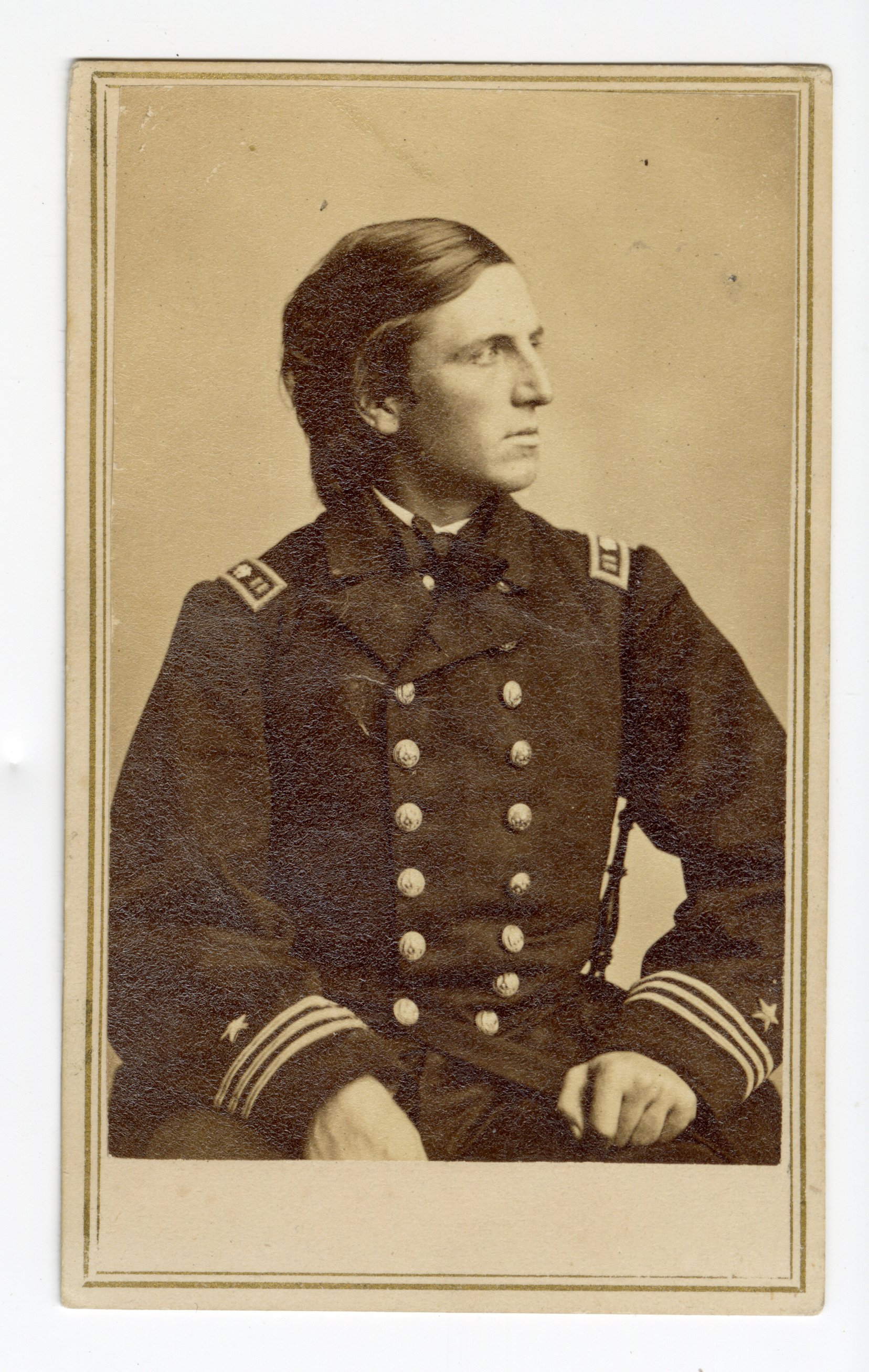
William B. Cushing
Price: $650.00
Description
William Barker Cushing (4 November 1842 – 17 December 1874) was an officer in the United States Navy, best known for sinking the CSS Albemarle during a daring nighttime raid on 27 October 1864, for which he received the Thanks of Congress. Cushing was the younger brother of Medal of Honor recipient Alonzo Cushing. As a result, the Cushing family is the only family in American history to have a member buried at more than one of the United States Service Academies.Cushing was born in Delafield in the Territory of Wisconsin, and was the youngest of four brothers and had two sisters. After his father died from pneumonia when he was still a young child, the family relocated to Fredonia, New York. He was expelled from the United States Naval Academy, just before graduation, for pranks and poor scholarship. In particular, he received a failing grade in Spanish after drawing a picture of the Spanish professor biting a horse. The Spanish professor was offended because, in actuality, the horse had bitten him. At the outbreak of the American Civil War, however, he pleaded his case to United States Secretary of the Navy Gideon Welles himself, was reinstated and went on to acquire a distinguished record, frequently volunteering for the most hazardous missions. "His heroism, good luck and coolness under fire were legendary."
Cushing saw action during the Battle of Hampton Roads and at Fort Fisher, among many others. He was promoted to lieutenant in 1862, and to commander in 1872. Two of his brothers died in uniform, Alonzo H. Cushing in the Battle of Gettysburg, for which he was awarded the Medal of Honor, and Howard B. Cushing, while fighting the Chiricahua Apaches in 1871. His eldest brother, Milton, served in the Navy as a paymaster.
It was Cushing's daring plan and its successful execution against the Confederacy's ironclad ram CSS Albemarle that defined his military career. The powerful ironclad dominated the Roanoke River and the approaches to Plymouth through the summer of 1864. By autumn, the U.S. government decided that the situation should be studied to determine if something could be done. The U.S. Navy considered various ways to destroy Albemarle, including two plans submitted by Lieutenant Cushing. They finally approved one of his plans and authorized him to locate two small steam launches that might be fitted with spar torpedoes.
Cushing discovered two 30-foot (9.1 m) picket boats under construction in New York and acquired them for his mission. On each he mounted a 12-pound Dahlgren howitzer and a 14-foot (4.3 m) spar projecting into the water from its bow. One of the boats was lost at sea during the voyage from New York to Norfolk, Virginia, but the other arrived safely with its crew of seven officers and men at the mouth of the Roanoke. There, the steam launch's spar was fitted with a lanyard-detonated torpedo.
On the night of 27–28 October 1864, Cushing and his men began working their way upriver. A small cutter accompanied them, its crew having the task of preventing interference by the Confederate sentries stationed on a schooner anchored to the wreck of the USS Southfield. When both boats, under the cover of darkness, slipped past the schooner undetected, Cushing decided to use all 22 of his men and the element of surprise to capture Albemarle.
As they approached the Confederate docks, their luck turned and even though under the cover of darkness they were spotted by a guard dog. They came under heavy sentry fire from both the shore and aboard Albemarle. As they closed with Albemarle, they quickly discovered she was defended against approach by floating log booms. The logs, however, had been in the water for many months and were covered with heavy slime. The steam launch rode up and then over them without difficulty. When her spar was fully against the ironclad's hull, Cushing stood up in the bow and detonated the torpedo's explosive charge.
The explosion threw everyone aboard the steam launch into the water. Recovering quickly, Cushing stripped off his uniform and swam to shore, where he hid until daylight. That afternoon, having avoided detection by Confederate search parties, he stole a small skiff and quietly paddled down-river to rejoin the Union forces at the river's mouth. Of the other men in Cushing's boat, William Houghtman escaped, John Woodman and Richard Higgins were drowned, and 11 were captured.
Cushing's daring commando raid blew a hole in Albemarle's hull at the waterline "big enough to drive a wagon in." She sank immediately in the six feet of water below her keel, settling into the heavy bottom mud, leaving the upper armored casemate mostly dry and the ironclad's large Stainless Banner battle ensign flying from its flag staff, where it was eventually captured as a Union prize.
Both of Cushing’s brothers were killed in combat. His oldest brother, Alonzo Cushing died at the battle of Gettysburg during Picket’s Charge. Howard Cushing died in 1871 fighting the Apaches. William Baker Cushing died 17 December 1874, possibly due to injuries he sustained and/or suffered from the Albemarle sound mission.
Source: Wikipedia