
❮
![Large Image]() ❯
❯
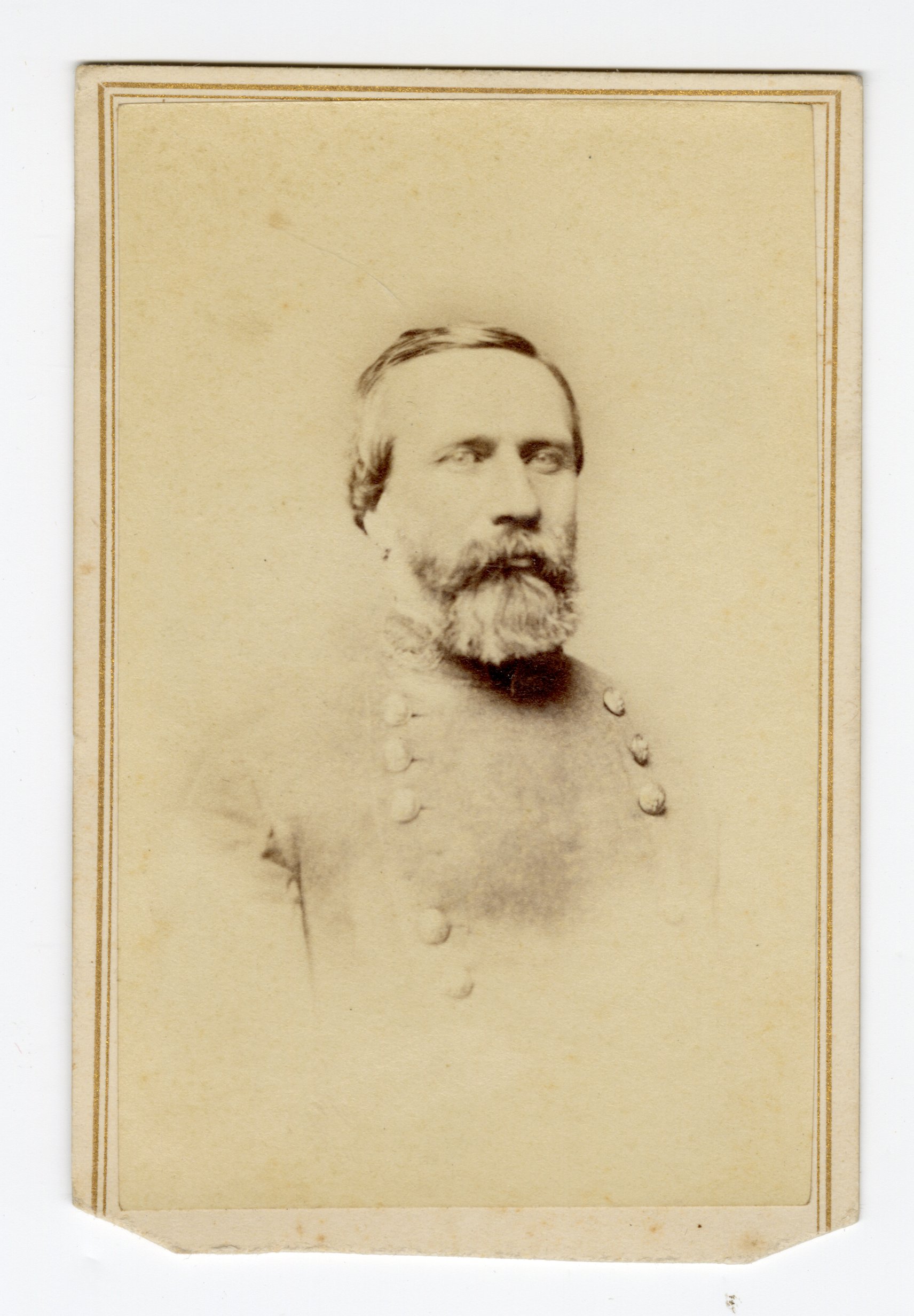
General Richard H. Anderson - Gettysburg Division Commander
Item CON-11502
Price: $650.00
Description
Richard Heron Anderson (October 7, 1821 – June 26, 1879) was a career U.S. Army officer, fighting with distinction in the Mexican–American War. He also served as a Confederate general during the American Civil War, fighting in the Eastern Theater of the conflict and most notably during the 1864 Battle of Spotsylvania Court House. Anderson was also noted for his humility.Anderson resigned from the U.S. Army (accepted on March 3, 1861) to enter service with the Confederate States Army. Anderson accepted a commission as colonel of the 1st South Carolina Regulars on January 28. He was given command of the Charleston, South Carolina harbor area after the capture of Fort Sumter that April. He was promoted to brigadier general on July 19 and transferred to Pensacola, Florida, where he was wounded in the left elbow during the Battle of Santa Rosa Island on October 9.
After recovering, Anderson joined the Confederate Army of the Potomac in February 1862 (which was absorbed into the Army of Northern Virginia later in the spring) as a brigade commander. Anderson distinguished himself during the Peninsula Campaign, temporarily assuming division command at Seven Pines when General James Longstreet was serving as a wing commander. At Seven Pines, he gained the sobriquet "Fighting Dick", and was promoted to major general on July 14 and received command of General Benjamin Huger's former division. As part of Longstreet's corps, Anderson fought at Second Bull Run. His division engaged the final U.S. defensive line around Henry House Hill, but the sun started going down, and he did not press the attack.
During the Maryland Campaign, General Cadmus Wilcox's brigade was added to Anderson's command. At the Battle of Antietam in September 1862, he was in overall command at the sunken road, or "Bloody Lane", in the center of the Confederate defense. He was wounded in the thigh and left the battle. His senior brigadier Roger A. Pryor took over command. After Anderson's departure, his division faltered and eventually succumbed to U.S. flank attacks that routed them from their position. His division was not heavily engaged at the Battle of Fredericksburg that December.
During the Battle of Chancellorsville in May 1863, while operating away from Longstreet's command (because Longstreet was on detached duty near Suffolk, Virginia, at the time), Anderson pressed the U.S. left while Lt. Gen. Thomas J. "Stonewall" Jackson attacked the right. Anderson and Maj. Gen. Lafayette McLaws left the main battle line on May 3 and struck east to check the advance of U.S. Maj. Gen. John Sedgwick's VI Corps that would have led into Gen. Robert E. Lee's rear. Following the death of Stonewall Jackson on May 10, Lee reorganized his army from two into three corps. Anderson was admired enough by Lee to be considered for corps command, but instead, his division was assigned to the new Third Corps, commanded by now Lt. Gen A.P. Hill, who outranked Anderson and was one of the senior-most generals in the army. After reorganizing, Anderson retained most of his existing command except for Brig. Gen Lewis Armistead's brigade, which was reassigned to George Pickett's division.
At the Battle of Gettysburg in July 1863, Anderson's division was third in the line of march approaching the town from the west on July 1, so they arrived late and had little involvement in the start of the battle.
On July 2, the second day of battle, Anderson's division attacked near the U.S. center, following on from attacks by Longstreet (the divisions of Maj. Gens. John B. Hood and McLaws) to his right. Anderson's right was successful in attacking U.S. Brig. Gen. Andrew A. Humphreys's III Corps division along the Emmitsburg Road. His center, under Ambrose R. Wright, penetrated the lightly defended Cemetery Ridge. Carnot Posey moved haltingly and William Mahone did not move from Seminary Ridge at all. U.S. reinforcements rushed to counter Wright, and he was repulsed. Anderson was criticized for his command during this day of battle. He had little effective control of his brigades. On July 3, Anderson's brigades participated in the waning minutes of Pickett's Charge, but both were driven back.
During the spring of 1864, at the Battle of the Wilderness, Longstreet was severely wounded, and Anderson took command of the First Corps, leading it throughout the Overland Campaign. After the Wilderness, he fought well at the Battle of Spotsylvania Court House. Anderson and his corps executed an all-night forced march on May 7 that secured that important position (reinforcing the Confederate cavalry earlier sent there) and arrived just before U.S. soldiers did. Reaching and defending this spot denied the U.S. soldiers a way around Lee's army towards Richmond, and Anderson held it during heavy fighting from May 8–12.
Anderson then fought at the Battle of Cold Harbor in early June and participated in the rest of the Army of Northern Virginia's operations to the south of Petersburg, Virginia, from mid-June until October. Anderson was promoted to temporary lieutenant general on May 31.
When Longstreet returned from his convalescence on October 19, 1864, Lee created the new Fourth Corps, which Anderson led through the Siege of Petersburg and the retreat towards Appomattox Court House in 1865. Because of several attacks by U.S. cavalry nipping at his corps, Anderson was forced to slow, occasionally stop, and beat off the attacks. This caused the Confederates to become isolated from the rest of Lee's army, moving west, and they were now the army's rear guard. The corps finally halted and fought at Sayler's Creek on April 6, which ended in a rout, and as Lee witnessed it, he exclaimed, "Has the army been dissolved?" As the corps' survivors reformed and rejoined the army, what was left of the Fourth Corps was merged with the Second Corps on April 8. This left Anderson without a command, and he proceeded home to South Carolina. Anderson assumed command of M. H. Hannon's Cavalry Brigade after Hannon was wounded at Monroe's Crossroads. Anderson was pardoned on September 27, 1865, although there is no record of his parole.
Source: Wikipedia