❮
![Large Image]() ❯
❯
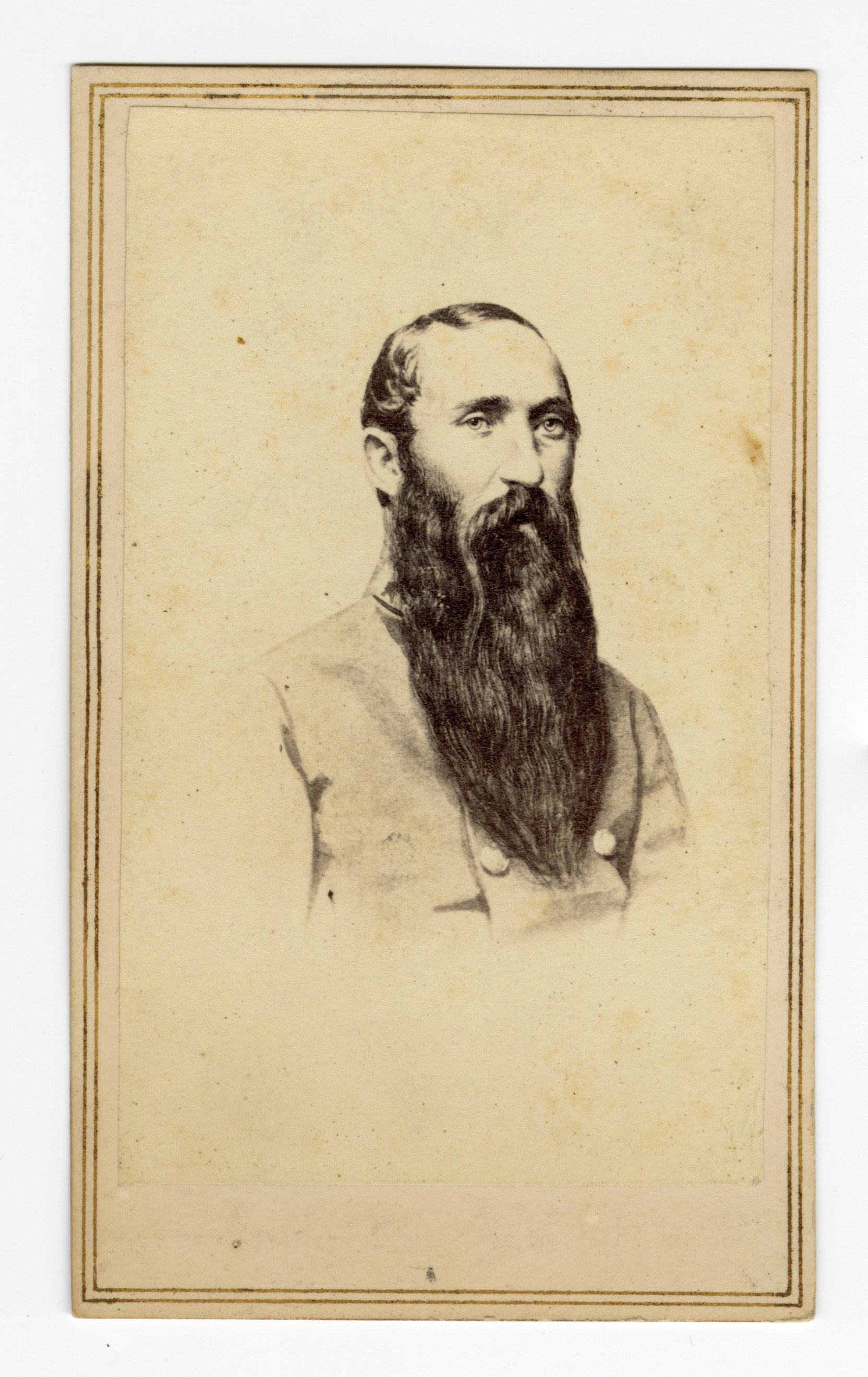
Albert Gallatin Jenkins - Brigade Commander at Gettysburg
Item CON-11506
Price: $550.00
Description
With the outbreak of the Civil War and Virginia's subsequent secession, Jenkins raised a company of mounted partisan rangers, which by June was enrolled in the Confederate Army as a part of the 8th Virginia Cavalry, with Jenkins as its colonel. The company was first organized to protect a Virginia flag that had been raised in Guyandotte, which they did until April 20, 1861. He fought at the Battle of Scary Creek on July 17, 1861, taking command of the confederate force when George S. Patton was wounded, and defeating the Union forces. By the year's end, his men had become such a nuisance to the Federals in western Virginia that military governor Francis H. Pierpont appealed to President Abraham Lincoln to send in a strong leader to stamp out the rebellion in the area. Early in 1862, Jenkins was elected as a delegate to the First Confederate Congress. After promotion to brigadier general on August 1, 1862, he returned to active duty. Throughout the fall, his men harassed Union troops and supply lines, including the vital Baltimore and Ohio Railroad.In September, Jenkins's cavalry raided northern Kentucky and now West Virginia. They briefly entered extreme southern Ohio across from Ravenswood, West Virginia, becoming one of the first organized Confederate units to enter a Northern state. In December, Robert E. Lee requested that Jenkins and his men transfer to the Shenandoah Valley.
After spending the winter foraging for supplies, he led his men on a raid in March 1863 through western Virginia, seeking to influence the popular vote which ultimately created the state of West Virginia. During the Gettysburg campaign, Jenkins's brigade formed the cavalry screen for Richard S. Ewell's Second Corps. Jenkins led his men through the Cumberland Valley into Pennsylvania and seized Chambersburg, burning down nearby railroad structures and bridges. He accompanied Ewell's column to Carlisle, briefly skirmishing with Union militia at the Battle of Sporting Hill near Harrisburg. During the subsequent Battle of Gettysburg, Jenkins was wounded on July 2 and missed the rest of the fighting.
Jenkins did not recover sufficiently to rejoin his command until fall 1863, and spent the early part of 1864 in and around Monroe County, West Virginia, assembling cavalry units for John C. Breckinridge's Department of Western Virginia.
By early May, the Confederates in southwestern Virginia had learned that a large Union force under Brig. Gens. George Crook and Brig. Gen. William W. Averell, had departed Charleston, and was rapidly approaching,- undoubtedly with the aim of striking the vital Virginia and Tennessee Railroad in the region. At the same time came news that 200 miles to the north, a Union force under Maj. Gen. Franz Sigel, was making a simultaneous advance in the lower Shenandoah Valley. Sigel's force posed the greater immediate danger, because of its proximity and potential to threaten the left flank of Gen. Lee's main Confederate army while it was engaged against Grant in central Virginia.
Despite the imminent arrival of Crook and Averell's force, Breckinridge received orders on May 4, to hastily move, with all the infantry of his department, to the Shenandoah Valley, where he could confront Sigel. Breckinridge complied, leaving his headquarters at Dublin, Virginia on the evening of May 5, and sending a dispatch to Jenkins appointing him as new Commander of the Department of Western Virginia.
Hearing that Union Brig. Gen. George Crook had been dispatched from the Kanawha Valley with a large force, Jenkins took the field to contest the Federal arrival. On May 9, 1864, he was severely wounded and captured during the Battle of Cloyd's Mountain, a Union victory which destroyed the last railroad line connecting Tennessee and Virginia.
A Union surgeon amputated Jenkins's arm, but he never recovered, dying twelve days later. He was initially buried in New Dublin Presbyterian Cemetery. After the war, his remains were reinterred at his home in Greenbottom, near Huntington, West Virginia. He was later reinterred in the Confederate plot in Spring Hill Cemetery in Huntington.
Source: Wikipedia