
❮
![Large Image]() ❯
77th New York Infantry & 6th Army Corps - Gettysburg Surgeon - NEW
Item LTR-12125
August 13, 1864
George T. Stevens
Price: $345.00
Description
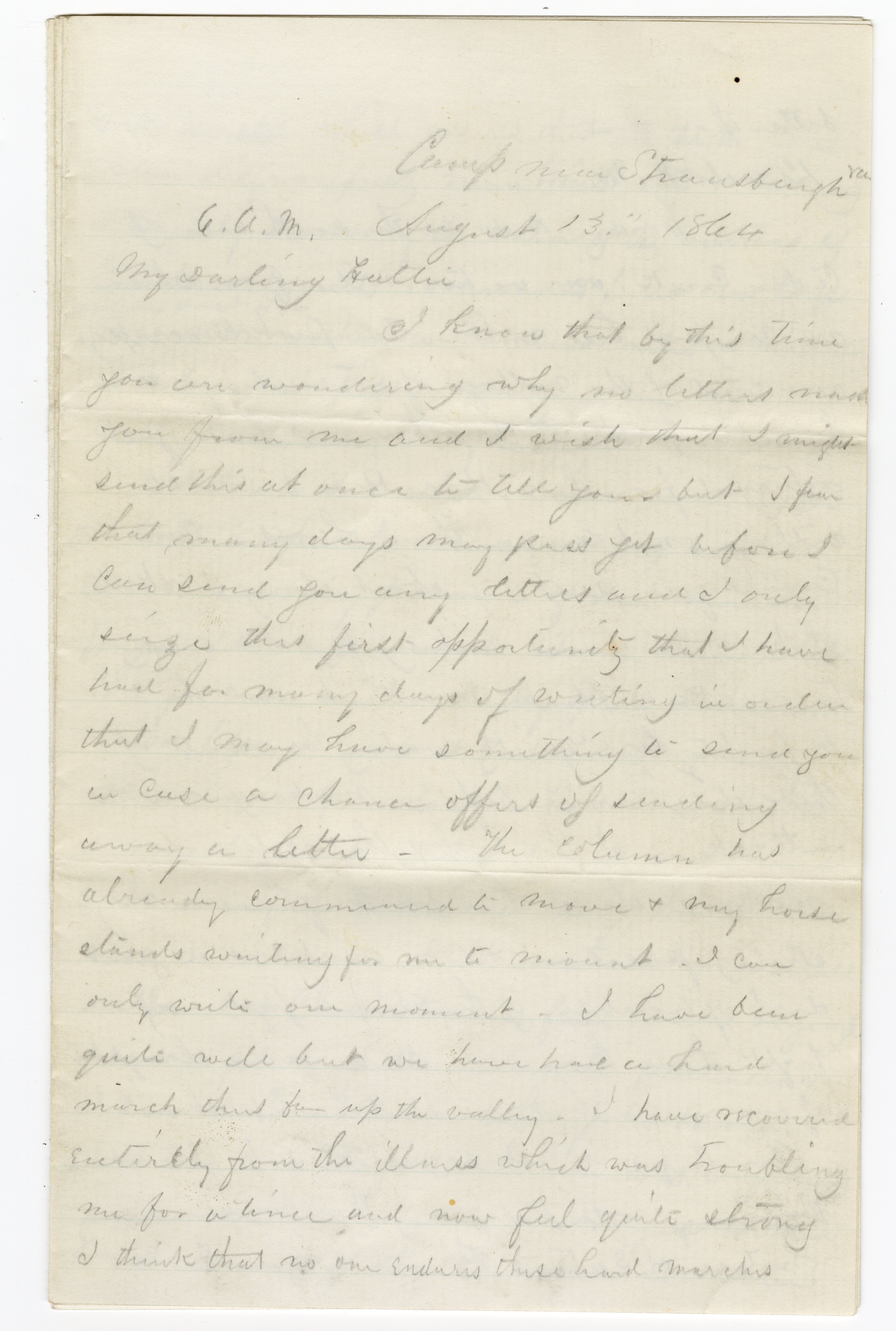
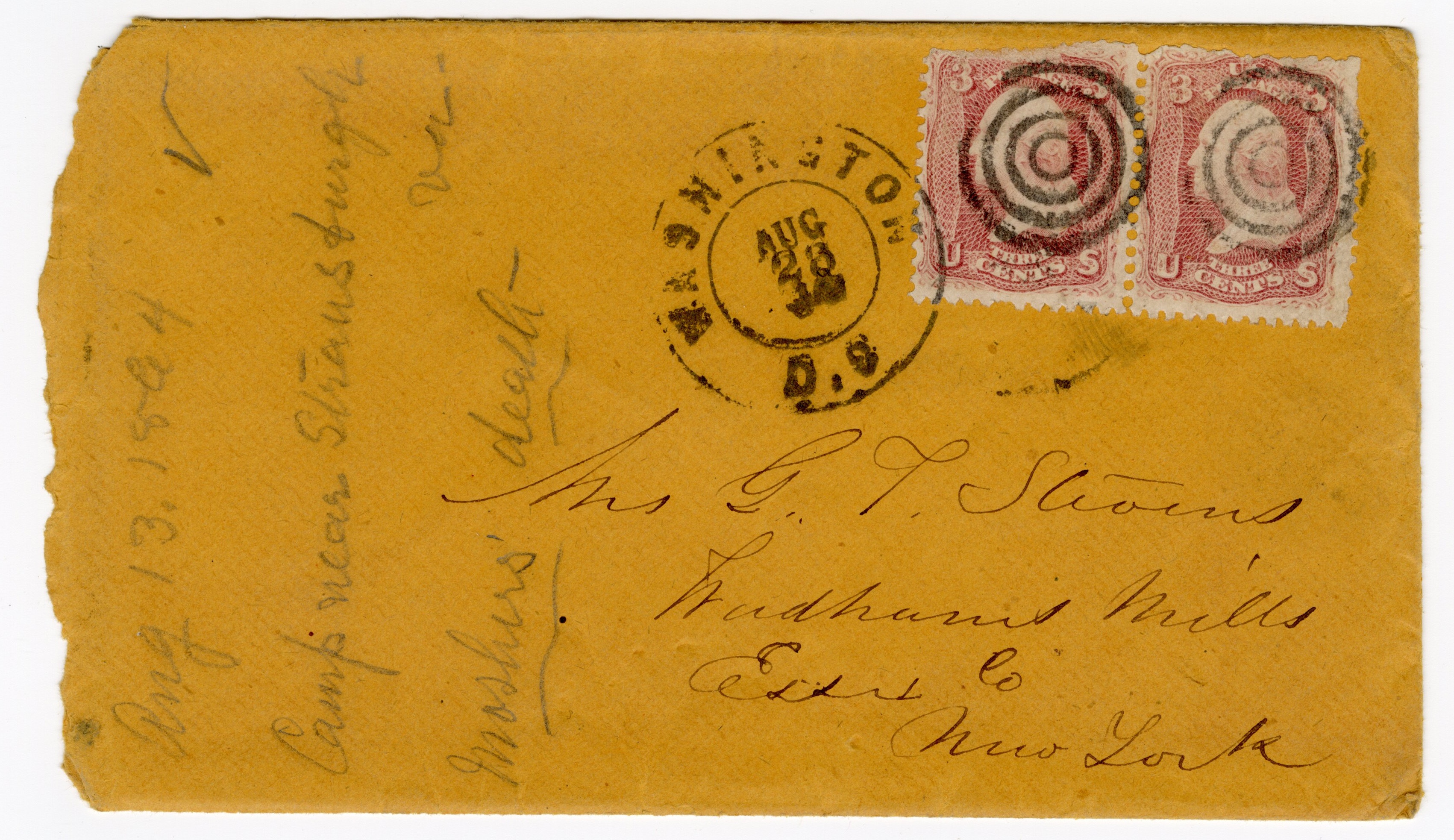
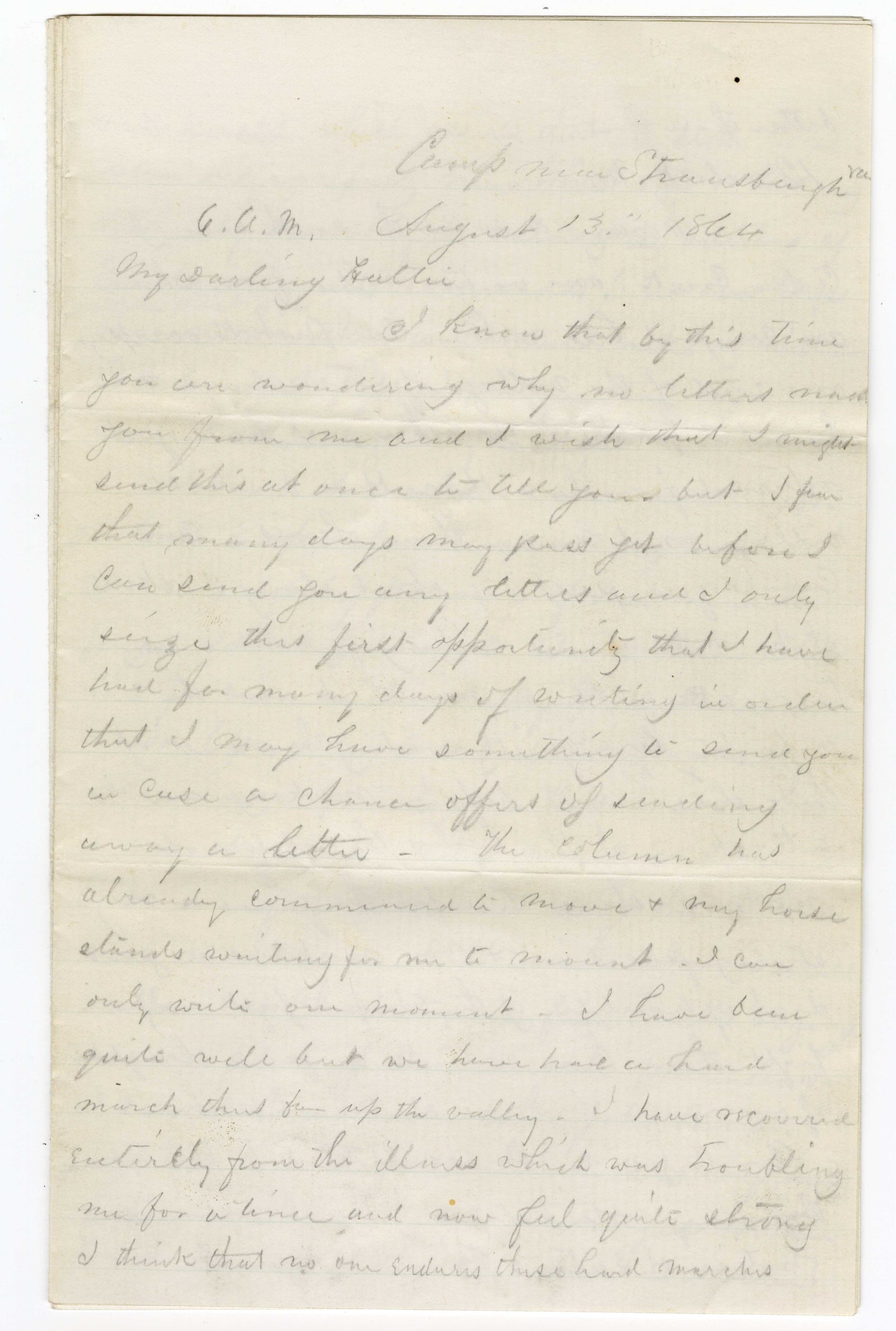
Original Civil War letter. 11 pages written in period pencil & ink.Camp near Strasburg, Virginia
August 13, 1864
6 a.m.
My Darling Hattie,
I know that by this time, you are wondering why no letters sent you from me. I wish that I might send this out once to tell you, but I fear that many days may pass yet before I can send you any letters. I only seize this first opportunity that I have had for many days of writing in order that I may have something to send you. In case a chance offers of sending away a letter, the column has already commenced to move, and my horse stands waiting for me to mount. I can only write one moment. I have been quite well, but we have had a hard march thus far up the valley. I have recovered entirely from the illness, which was troubling me for a time, and now feel quite strong. I think that no one endures these hard marches better than I.
12 o’clock p.m.
We are now on the south side of Cedar Creek, one or two miles from where we camped last night. Our pickets occupy one end of the villages of Strasburg, and the Rebel pickets the other. I have just returned from the villages.
It is a small village, not larger than Lewiston. Our cavalry is pushing about along the skirts of the mountains, seeking for some way to make a flank movement. The infantry are quietly waiting the result of their discoveries, before making an attack. I think that the Rebels will make a stand here, for they have a very strong position and can make us a great deal of trouble if they choose to fight. If we fight them, there will be a great slaughter of our men, but we should whip them.
Our corps is not accustomed to fly before the enemy, notwithstanding the complimentary notice of Satan's official organ. The new York Herald, which asserts that the Sixth Corps ran disgracefully near Winchester, and the army was only saved by the valor of the veterans of Crook's and Averell's commands! As our corps, or any part of it, was not within 100 mi of Winchester at the time of the fight, I presume they were not badly demoralized by it.
I think that while we are waiting for the ball to open, I will spend my time in writing a brief journal of our march for you. I think you would like to know what it is to be seen in the Valley of the Shenandoah.
We left our camp at Hall Town Wednesday morning at 5 o'clock. The sun as soon as it rose, began to scorched terribly, and it proved to be one of the worst days that I have ever marched in. Old town was but a small village, but Charleston, 5 mi beyond, was a place of considerable pretentiousness. I saw the courthouse where John Brown was tried and the jail where he was confined. Both were completely destroyed, within and much of the external structure was torn down. The townspeople were not at all our friends, though of course they treated us civilly. A little further on, I saw a lovely meadow lying between two groves of fine oak trees. The place looked so attractive that my companion, the provost marshal, and I made away from the column to enjoy a nice white cottage at the farther end of the meadow. Invited us still further, and we sat down on the grass under the shade of the trees. The family gathering about us, they brought us a draught of ice water. Water, they said, from a well sunk by General Braddock when he and Washington's command were on their campaign.
They also brought us milk and bread, and we had a feast of good things. We halted at night, having marched only about 12 mi, but we were all very tired, and the troops had suffered much from the heat of the sun.
Next morning, we were again on our way at 5 o'clock. It was a very hot day, but not quite as intensely hot as the day before. I suffered a great deal from thirst, for, though it may surprise you, we have never had so much trouble to find water as in the garden of Virginia.
My poor horse had not a drop of water from 5 o'clock until nearly sundown. As we have had nearly marched the end of our journey, I saw a spring near a house under the shade of a huge willow. The water gushed from a fixture in the rock and was as clear as crystal.
Over a part of a house was erected. The house was filled. The rocks covered, and the little grove crowded for many guards with soldiers eager to fill their cups and canteens. The pony crowded in and thrust his head up to her eyes in the water, whilst I drank from a black sooty coffee pot with much delight. than ever a picture of his choicest wine.
No one can have any idea of the perfect delight afforded by a cup of cool water who has not suffered the pangs of extreme thirst. I do not wonder that, in eastern countries, wells are sacred places.
I made my bed under a tree as usual and slept with the greatest vigor. I must not forget to mention one of the most important incidents of the day. Billy McCool came in at night with a beautiful young cow for me. She is a great prize to me, giving 10 qt of nice milk each day and an assurance of three good meals a day. Whatever may be tied to the commissary, you know that our cows that we had on the peninsula had to be left.
Though when we came away, I cannot eat hard crackers and coffee and work, but I can get along very well with milk.
Since I wrote the last sentence, the boys brought me a cup of milk, a plate of honey, and a stew of lamb. You see, I am not in a way to starve. Yesterday was another extremely hot day, worse than any of its predecessors. A great many men fell down by the roadside with sunstroke. Water was as scarce as the day before.
I drove my horse into a stagnant pond to let her drink toward night, but a dozen water snakes stuck their heads above water, and I bent a hasty retreat with the mare, for I was not ready to have her die from the bite of one of those disgusting creatures. I bivouacked on the grass with the beautiful canopy of heaven, with its moderate clouds and twinkling stars and flying meteors, for my tent. That is the only tent that I have had since I left Petersburg, and I like it best of any.
The air is pure and the breeze is fresh, fresher than when it has to come through canvases. Just now, the thunders are rolling and the lightning flashing at a little distance. If we get a shower, I shall want a better shelter than this gives. Perhaps I will have the boys bring a hospital fly.
I have been disappointed in the appearance of this valley. We have always heard it called the Garden of Virginia, but it does not compare with our Mohawk Valley. It is not half as fruitful or so beautiful as our Champlain's Valley, and bears no sort of comparison with the valley of the Hudson.
The splendid groves of oak are the principal feature of beauty. I have never seen so fine groves. Wagons can be driven anywhere through them, and there is none of that undergrowth that is so troublesome in our groves at home. The stacks of wheat and rye show as good but not an extraordinary growth of grain. What has been raised has been nearly all taken away by the Rebel army. This part of the Valley and all that we came through yesterday is poor. The forest has but little oak timber, while scrub pines and redlands abound. If this is the most fruitful part of Virginia, I pity the barren portions.
I was awakened this morning by sad intelligence, intelligence that John Mosher had died during the night. You remember that John was my orderly for a long time. I will remember him well indeed.
I believe that he and Dale have always kept up a correspondence. Poor fellow, I found him stark and cold. Yesterday, he was overcome by the heat of the sun and got his knapsack carried in on an ambulance. Said he did not come to ride. Toward night, he walked with Billy McCool and said his head ached and his face burned. He turned aside to get some water, and Billy lost sight of him.
Soon after, he was found at the roadside and put in the ambulance of the First Division. He was then insensible, and they could not ascertain where he belonged. The surgeons of the First Division did all that could be done for him. But he died at midnight. After his death, they found his name in his pocketbook. So we found out his fate. This morning, I stood with the chaplain and a few of his friends at his grave. We folded him in his blanket. The chaplain read a short service. A few tears were dropped, and we left. A friend beneath the clay of the Valley. John has a wife and two children, living at Bulston. More sad hearts.
August 14th
We are now back in the place where I commenced this letter. We have had no fight and no prospect of one today. I do not know why.
I must send this at once, so goodbye.
Your own affectionate,
George T. Stevens